
Dorchester Parole Versus Probation
Maryland assigns the decision and supervision roles to separate parts of the Department of Public Safety and Correctional Services. The Maryland Parole Commission decides whether an eligible state prisoner should receive discretionary parole. The Division of Parole and Probation supervises people living in the community on parole, mandatory supervision, and probation. This split matters when checking a Dorchester County record. The Commission can document an approval, denial, or later hearing, while DPP is the better route for the office responsible after release.
Probation comes from a court. It may follow a jail term, replace part of a suspended sentence, or begin without a prison stay at all. Parole is conditional release from a state correctional term before maximum expiration. Mandatory supervision is a conditional release produced by applicable sentence credits. A person on parole or mandatory supervision continues serving the balance in the community. None of these labels, standing alone, confirms the date the person walked out of a facility.
| Status | Who authorizes it | What it establishes |
|---|---|---|
| Parole | Maryland Parole Commission | Conditional release from a state sentence, subject to requirements and DPP supervision |
| Mandatory supervision | Maryland law and the sentence-credit calculation | Conditional community status for the undiminished part of a sentence |
| Probation | District or Circuit Court | Court-ordered supervision that may or may not follow incarceration |
| Discharge | The agency or court governing the status | The particular supervision term has ended |
- Parole
- Discretionary release approved by the Parole Commission before a sentence reaches its maximum end.
- Probation
- Court-ordered community supervision, often tied to a suspended sentence and stated court conditions.
- Mandatory supervision
- Release based on valid diminution credits, with the remaining term supervised in the community.
- Absconder
- A formal status that should be used only when an authorized agency or court record establishes it.
Verify Dorchester Post-Release Supervision
Maryland has no official public name-search database for ordinary parole or probation clients. Verification therefore starts with the record that created the status and a direct inquiry to the proper office. Use a full name and enough lawful identifying detail to avoid matching the wrong person. Staff may limit what they disclose because supervision and case files can contain protected information.
- Read the Dorchester District or Circuit Court docket for a probation order, sentence, violation filing, warrant entry, or later discharge.
- For parole or mandatory supervision, review any Maryland Parole Commission notice or decision. Treat a grant as approval, not proof of physical release.
- Call the Cambridge DPP Field Office and ask whether it can confirm supervision or identify the office assigned under the person’s approved residence plan.
- Use Maryland VINE for a custody or status notice when available, but pair the alert with the jail, prison, court, or DPP record.
- When a documentary response is needed, make a focused Public Information Act request for the nonconfidential part of the relevant DPP or Commission record.
A Dorchester conviction does not guarantee supervision in Cambridge. DPP assignment follows the actual supervision plan and residence. Likewise, a person released from a prison elsewhere in Maryland may report to Cambridge because the approved residence is in Dorchester County. Ask for the assigned office instead of assuming it from the court or prison location.
Important: A supervision record confirms a legal status. Confirm physical release separately through the custodian, VINE, or a release transaction.
Dorchester County Supervision Office
The DPP office directory identifies the Cambridge Field Office as the local point for Dorchester County. It can route a supervision question and identify the right office when disclosure rules permit. It is not a public person-name search service, and a caller should expect limits on case details. Court records remain the primary source for probation terms, while Commission records explain a parole action.
310 Gay Street
Cambridge, MD 21613
Phone: 410-901-8460
Fax: 410-228-5851
DPP headquarters is at 6776 Reisterstown Road, Suite 212, Baltimore, MD 21215, with phone numbers 410-585-3500 and 877-227-8031. The Maryland Parole Commission is in Suite 302 at the same street address and can be reached at 410-585-3200 or 877-241-5428. Use the Commission for parole decisions and DPP for day-to-day supervision routing.
Dorchester Parole Decisions and Release
A favorable parole result does not show that release occurred on the hearing date. The Maryland Parole Commission says an approved person may still need a certified home plan, a treatment or institutional program, and other pre-release conditions. Some grants identify a later month or year. Institutional misconduct or failure to complete a condition can also suspend favorable action.
Commission terms must be read with care. A grant approves parole subject to requirements. A refusal or denial rejects release at that consideration. A rehearing sets another review, while a continuance or deferral leaves work or information outstanding. A favorable action may later be suspended or rescinded in recognized circumstances. None of these terms equals the final custody transaction.
Maryland does not provide a general official name-based parole-decision search. The Commission’s public business meetings occur every other Wednesday in Baltimore, but those meetings are not a calendar of every individual interview. Its published open-hearing master list for 2025 is stale for a current 2026 check. Contact the Commission or use a focused records request for a named result. Under Correctional Services §7-304, votes to approve or deny parole are publicly available in the open-hearing framework.
Dorchester Supervision Conditions and Violations
Conditions differ by case and status. A person may have reporting duties, an approved residence, treatment requirements, travel limits, or other terms stated in the court order, parole certificate, or supervision record. Those specific documents control. Do not infer a violation from a missed appointment, rumor, or an old docket entry.
A violation allegation can lead to a court filing, warrant, revocation process, or return to custody. Parole and mandatory-supervision violations follow the applicable DPSCS and Commission process; probation violations return to the sentencing court. Revocation means the conditional status is withdrawn after the required process and can result in renewed custody. It should not be assumed from a roster appearance without matching the case and authority.
Maryland VINE can provide status notifications from participating agencies. It is useful when custody changes, but it does not replace a DPP record or court docket. Record the notice date, source agency, and event label, then confirm what that label means with the responsible office.
Note: A supervision condition is case-specific, so the controlling order or certificate is more reliable than a general summary.
No Dorchester Absconder Search
No official Dorchester County public absconder list was found in the research. That absence prevents a reliable name lookup through a local web page. It also means a person should not be labeled an absconder merely because the person cannot be reached or appears to have missed a DPP contact. The word describes an agency-established status, not a lay conclusion.
Check the Maryland Judiciary Case Search for a violation petition, warrant, or related court event. Then contact the Cambridge field office for any confirmation it may lawfully provide. A public docket summary may be incomplete or delayed, and protected matters may not appear. If the issue is immediate safety, use the proper emergency or law-enforcement channel rather than treating a web search as current operational data.
When Dorchester Supervision Ends
Parole ordinarily continues until maximum expiration unless it is revoked or otherwise lawfully ended. Mandatory supervision covers the balance created by sentence credits. Probation ends under the court’s order, a later modification, discharge, or another authorized event. The end of one form of supervision does not establish that every case, warrant, registry duty, or federal condition has ended.
Ask for the document that records discharge or expiration. For probation, that is usually in the court file. For parole or mandatory supervision, DPP or the Commission may hold the controlling record. Maryland’s Public Information Act permits access to public records subject to exemptions, so a narrow request for the date and type of discharge is more useful than a demand for the entire case file. The full Dorchester County released-person search path explains how that document fits with custody and court sources on the home page.
Note: “Off supervision” describes the end of that status, not a finding about unrelated cases or another authority’s custody.
Dorchester Reentry Support After Release
The Dorchester Health Department describes Dorchester Addiction Reentry/Treatment, known as DART, as a voluntary program for eligible Detention Center participants diagnosed with a substance-use disorder. After release, services may include case management, recovery support, state care coordination, and transportation. This is a distinctive local reentry path, but it does not cover every released person.
DART is not a release-verification office. Participation does not prove the release date, parole status, or the end of a sentence. Use the Detention Center transaction for local physical departure, the court for its order, and DPP for supervision. Reentry support and legal supervision can operate at the same time, but they answer different questions.
Dorchester Supervision at Gay Street
The Cambridge DPP Field Office, Dorchester District Court, and District Court Commissioner share the 310 Gay Street address. That makes local routing convenient, yet it does not combine their files. The commissioner handles initial-appearance and pretrial-release matters. District Court maintains its cases. DPP manages eligible community supervision.
A person seeking a post-release status should ask the question at the correct door. The court can provide the probation order or docket entry. DPP can route a supervision inquiry, subject to disclosure limits. The Detention Center at Fieldcrest Road confirms local physical release. Keeping those records separate prevents a court order from being mistaken for a completed release or a supervision office address from being treated as a public database.
The direct Cambridge number, 410-901-8460, is useful when the assigned office is uncertain. Give a full name and explain that the request concerns routing or verification. Staff, not an unofficial list, determines what may be confirmed.
The official Maryland Parole Commission page shows its services and contact route. The image below captures that state source for Dorchester County parole records.
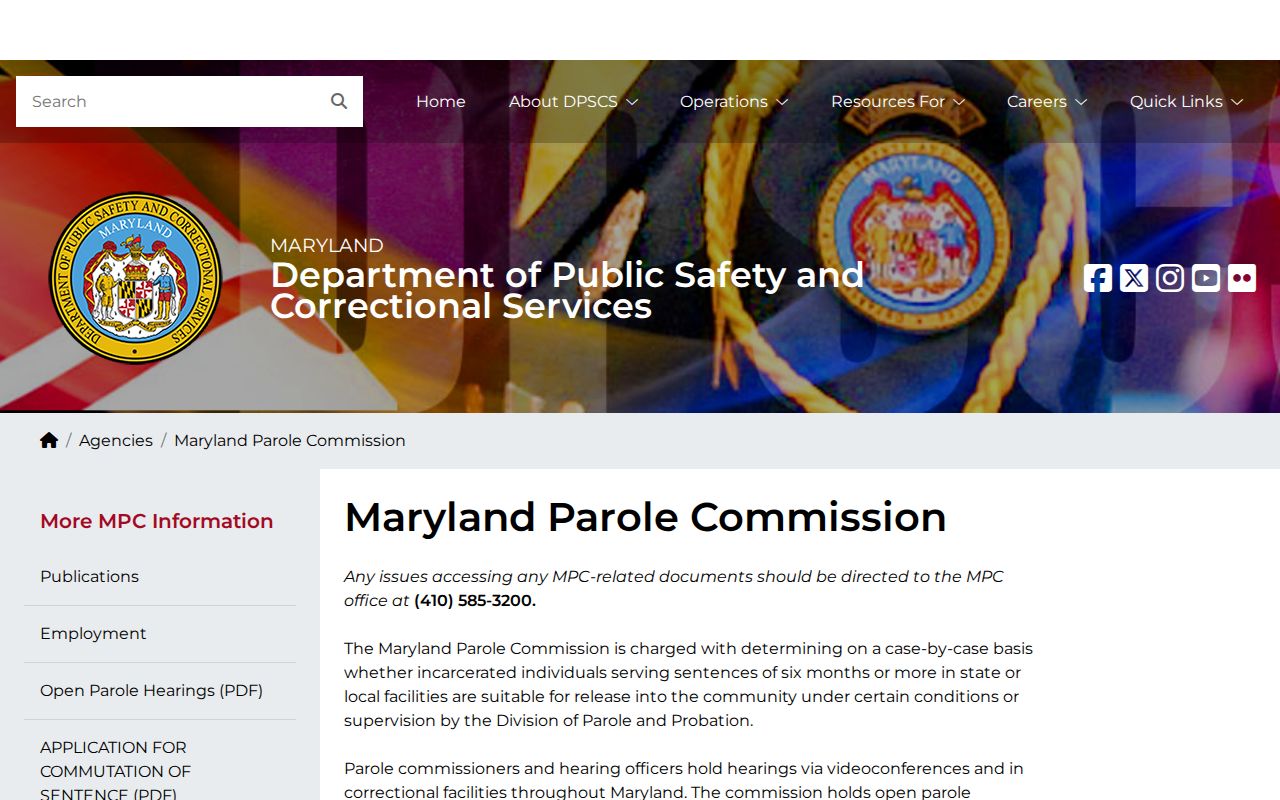
The Commission page supports parole-decision research, while the Cambridge DPP office remains the local supervision contact.