
No Dorchester 72-Hour Feed
Neither Dorchester County Corrections nor the Sheriff publishes a verified last-72-hours view. The Sheriff’s OCV system offers Inmate Search, but its records describe present detention. The inspected official feed contained only entries coded IN. It had booking times but no release time, release type, receiving agency, OUT status, three-day filter, update cadence, or retention rule for removed names.
The Dorchester County Department of Corrections page identifies the jail operator and its contact route. The corresponding capture shows no recent-release list or rolling window.
That division of roles is important. Corrections runs the Dorchester County Detention Center. The Sheriff channel publishes the current search. A three-day release inquiry should go to Corrections for the actual exit record, then to the court for the order or sentence event behind it. The Sheriff roster can establish a current listing at a given time, but it cannot replace either source.
Weekend caution: do not turn a roster change into a release claim. Build a dated timeline and confirm each departure with the facility or its record.
Build a Dorchester Three-Day Check
Start by fixing the window. Record a beginning and end date and time rather than asking who left “over the weekend.” A precise range makes the Detention Center inquiry and any later records request easier to search. It also prevents an event near midnight from being assigned to the wrong day. Call 410-228-8101 and ask whether a named person is held now. If not, ask for any publicly disclosable date, time, release type, and destination within the chosen period.
Then reconcile the custody answer with records from separate systems. The goal is not merely to find a missing roster name, but to identify the event that ended Dorchester custody.
- Set the exact three-day range and preserve the date and time of every search or call.
- Check the Dorchester Sheriff roster only for current status. Save the spelling and inmate ID if a matching entry appears.
- Ask Corrections whether local custody ended inside the range and whether the person returned to the community or entered another agency’s custody.
- Search Maryland VINE for a custody-change record or notification, then corroborate it because VINE warns against sole reliance.
- Read the matching District or Circuit Court chronology for bond, disposition, sentence, time-served, warrant, or transfer authority.
- Request the release transaction for durable proof when the phone response and public records do not fully resolve the event.
The narrow same-day method is covered under Dorchester County 24-Hour Releases. The three-day workflow is better when the interval crosses nonbusiness days or when an exact day is uncertain.
Note: A three-day search should preserve each system’s timestamp because the roster, VINE, court docket, and jail record may update at different times.
Dorchester 72-Hour Release Fields
There are no public Dorchester 72-hour list fields because no such list was found. The table separates details available from the current roster from the release facts that must be requested. This is more reliable than inferring an exit time from the last moment a person happened to appear online.
| Needed fact | Where Dorchester provides it |
|---|---|
| Full name and inmate ID | The current Sheriff feed may provide these matching details while the person is listed. |
| Booking date and time | The live feed includes it, but it does not establish the end of custody. |
| Release date and time | Not published in the feed; ask Corrections for the release transaction. |
| Release type and authority | Request the recorded basis and compare it with the court order or docket. |
| Destination or receiving agency | Request this field to distinguish community release from a custody transfer. |
| Case or warrant link | Use the releasable identifier to match the correct Dorchester court matter. |
The official Dorchester Sheriff search illustrates the current channel that can be mistaken for a release list.

Its public interface is useful for a snapshot of who is displayed as in custody. It does not expose what a true three-day release list would need: an affirmative release status, a dated event, the legal basis, and the next destination.
Dorchester Weekend Release Checks
A 72-hour interval often spans a weekend or holiday. That wider frame can catch a Friday evening event that is not reviewed until Monday, or it can separate several court and custody events that happened on different days. Dorchester does not publish a weekend release policy or rolling archive, so no fixed posting time should be promised. The public evidence must be assembled from event records.
Use the court chronology to locate the order, bond decision, dismissal, sentence completion, time-served entry, or warrant action. Court data explains legal authority. It usually does not certify the minute Corrections completed the physical exit. Another warrant or detainer may keep the person held after one matter authorizes release. Conversely, a transfer may end the Dorchester booking without freeing the person.
For each name, write a short custody timeline: last confirmed Dorchester listing, court authority date, Corrections release date and time, VINE change, and receiving agency if any. Missing steps should remain marked as unconfirmed. This method handles a multi-day gap better than comparing search screens and guessing what occurred between them. For one person with an uncertain custody path, the Dorchester County released inmate lookup explains how state, federal, immigration, and supervision channels differ.
Note: A court release order and physical jail departure are separate events, especially when another warrant, detainer, or receiving agency must be checked.
Dorchester Roster Release Blind Spot
Dorchester’s exact OCV data explains why a weekend list cannot be reconstructed after the fact. On the research date, the feed held only current entries marked IN. It did not retain a public row marked released, disclose when an entry was removed, or state how often its data refreshed. A before-and-after comparison can reveal absence, not cause.
The official Dorchester OCV feed was captured because it is the underlying source, not a third-party roster.
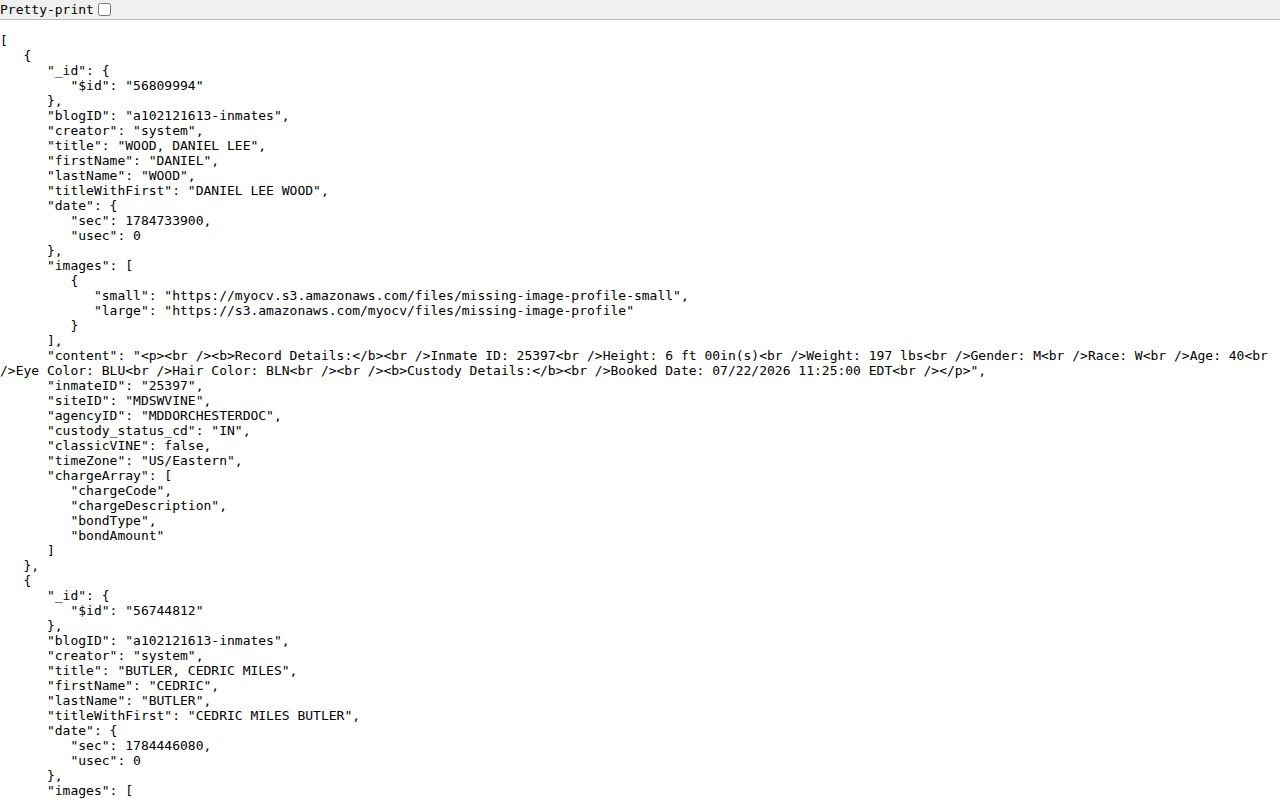
The visible fields include identity details, inmate ID, age, booked date and time, and agency and site identifiers. None supplies a release date or next destination. Images in the inspected data were generic placeholders, so they add no release evidence.
A former entry can vanish after bond, time served, sentence expiration, probation, transfer, escape, death, or a routine data change. Some outcomes are community releases. Others are not. State DOC custody, an out-of-county warrant, federal custody, ICE custody, treatment, or hospital transfer can all follow a local exit. Report only what a source affirmatively supports.
Dorchester Three-Day Release Request
When the 72-hour check needs a record rather than a phone answer, use Dorchester County’s Public Information Act form. Identify the Department of Corrections and Detention Center as the likely custodian. Give the named person, date of birth or inmate ID if known, and the exact three-day custody range. Ask for an existing booking and release transaction, not a new report of “all people released.” A narrow request reduces identity errors and limits unnecessary review.
Request booking date and time, release date and time, release type or authority, destination or receiving agency, and related case or warrant identifiers where releasable. Ask for an electronic copy, redaction of exempt material rather than withholding the full record, and a cost estimate before charges are incurred. The county form allows in-person, mail, and email submission. It also warns that formal production may take much longer than an urgent weekend status check, so the Detention Center call should come first.
Maryland VINE fills a different role. It can send or display a custody-change notice based on data from participating agencies. That notice can help place an event inside the three-day period, but VINE directs users not to rely on it as the sole source. Save its timestamp and confirm the result with Corrections or the court.
- Release transaction
- The facility record of when local custody ended and the type or destination recorded.
- Court authority
- The order, bond action, disposition, or sentence event that legally supports release on that matter.
- Custody notification
- A VINE alert or status change that helps track timing but still needs corroboration.
Dorchester Release Transfer Checks
The final three-day review asks where the person went. If Maryland Division of Correction custody is plausible, search the DPSCS current locator by first and last name. A match may show the current state facility. A miss is not a released-person record because DPSCS removes people no longer in its custody and expressly notes that release or escape can cause exclusion. Use the sentencing case, VINE, supervision records when relevant, or a DPSCS records request for a state discharge.
For federal custody, the BOP locator can show a past release date and a “Released” or “Not in BOP Custody” status for its own system. ICE’s locator covers current or recent immigration custody. Neither replaces Dorchester’s local release transaction. Each answers only whether that agency held the person.
The safest three-day conclusion names the system and the evidence: released from Dorchester custody at a stated time, transferred to a named receiving agency, or not displayed in a searched system at a recorded time. Avoid broader claims of freedom from all custody unless every relevant hold and transfer path has been resolved. That precision preserves the key difference between leaving the county jail and returning to the community.